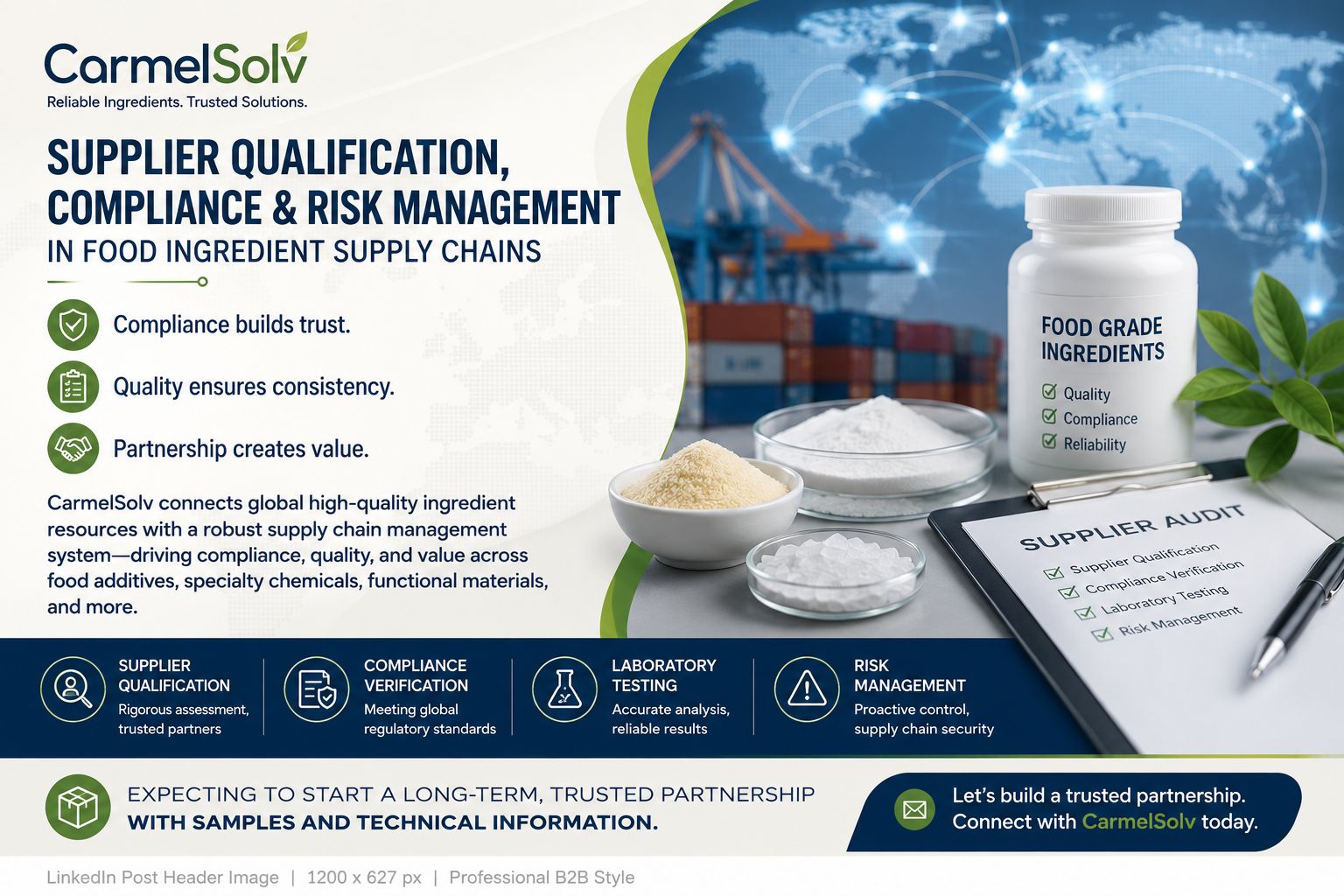
As demand grows across food ingredients, dietary supplements, and functional nutrition markets, procurement priorities are shifting beyond simple price negotiation.
For buyers, QA teams, and compliance managers, the key questions are no longer only about cost. They are about supplier reliability, documentation integrity, regulatory alignment, batch consistency, and long-term supply chain resilience.
In this environment, supplier qualification has become a critical part of risk management.
Key Procurement Priorities
For food-grade ingredients, specialty additives, and functional materials, buyers are increasingly focused on four execution pillars:
Supplier Reliability
A strong supplier must provide stable production capacity, transparent communication, and reliable long-term supply support.
Technical Documentation
Buyers need complete, accurate, and audit-ready technical documents, including TDS, SDS, COA, specification sheets, and batch-related records where applicable.
Regulatory Alignment
Materials must be reviewed against applicable FDA requirements, customer standards, state-level requirements, and destination-market compliance expectations.
Batch Consistency
Initial sample approval is only the beginning. Commercial supply must remain consistent against agreed specifications from batch to batch and shipment to shipment.
Global Supply Opportunities
China remains an important global supply base for many ingredient categories, including organic acids, sweeteners, plant extracts, functional blends, and specialty raw materials.
For the U.S. market, supply capacity alone is not enough.
The true challenge is verifying whether the supplier can meet the documentation, testing, traceability, and compliance expectations required by North American customers.
This is where supplier audits and quality verification become essential.
What U.S. Buyers Commonly Review
U.S. purchasing, QA, and compliance teams often focus on the following areas during supplier qualification:
- Product technical dossiers, including TDS, SDS, and batch-specific COAs
- Facility-level quality systems and cGMP-related capabilities where applicable
- End-to-end traceability from raw materials to finished batches
- Heavy metals testing, including lead, arsenic, cadmium, and mercury where relevant
- California Prop 65 considerations where applicable
- FDA registration or facility documentation where required
- Kosher, Halal, Non-GMO, allergen, or other customer-specific certifications where applicable
- Consistency between technical documents and actual production batches
Supplier qualification is now far more than a purchasing formality. It is a key part of protecting market access, product quality, and customer trust.
Three Critical Supply Chain Risks
1. Document Authenticity
Technical paperwork must align with the actual production batch, manufacturing site, and shipment records. Inconsistent or incomplete documentation can create serious audit and customer approval issues.
2. Quality Consistency
A successful sample does not guarantee stable commercial supply. Buyers need confidence that approved specifications can be maintained across repeated production lots.
3. Cross-Border Compliance Gaps
Differences in regulatory expectations, testing methods, documentation formats, and customer requirements can create costly friction during import, qualification, and commercialization.
Supply Chain Management and Value Creation
At CarmelSolv, we help bridge the gap between global ingredient resources and the rigorous demands of the North American market.
Our approach focuses on:
- Supplier qualification
- Compliance verification
- Technical documentation review
- Independent laboratory testing support
- Batch consistency monitoring
- Traceability review
- Proactive supply chain risk management
We support customers across food additives, specialty chemicals, functional materials, and related ingredient supply chains with a focus on quality, compliance, and reliable long-term supply.
Start with Samples and Technical Documentation
A trusted partnership begins with clear technical information.
For customers evaluating new suppliers or ingredient sources, CarmelSolv can support sample requests, COA review, technical documentation collection, and supplier qualification planning.
Let's build a more reliable, compliant, and resilient ingredient supply chain.