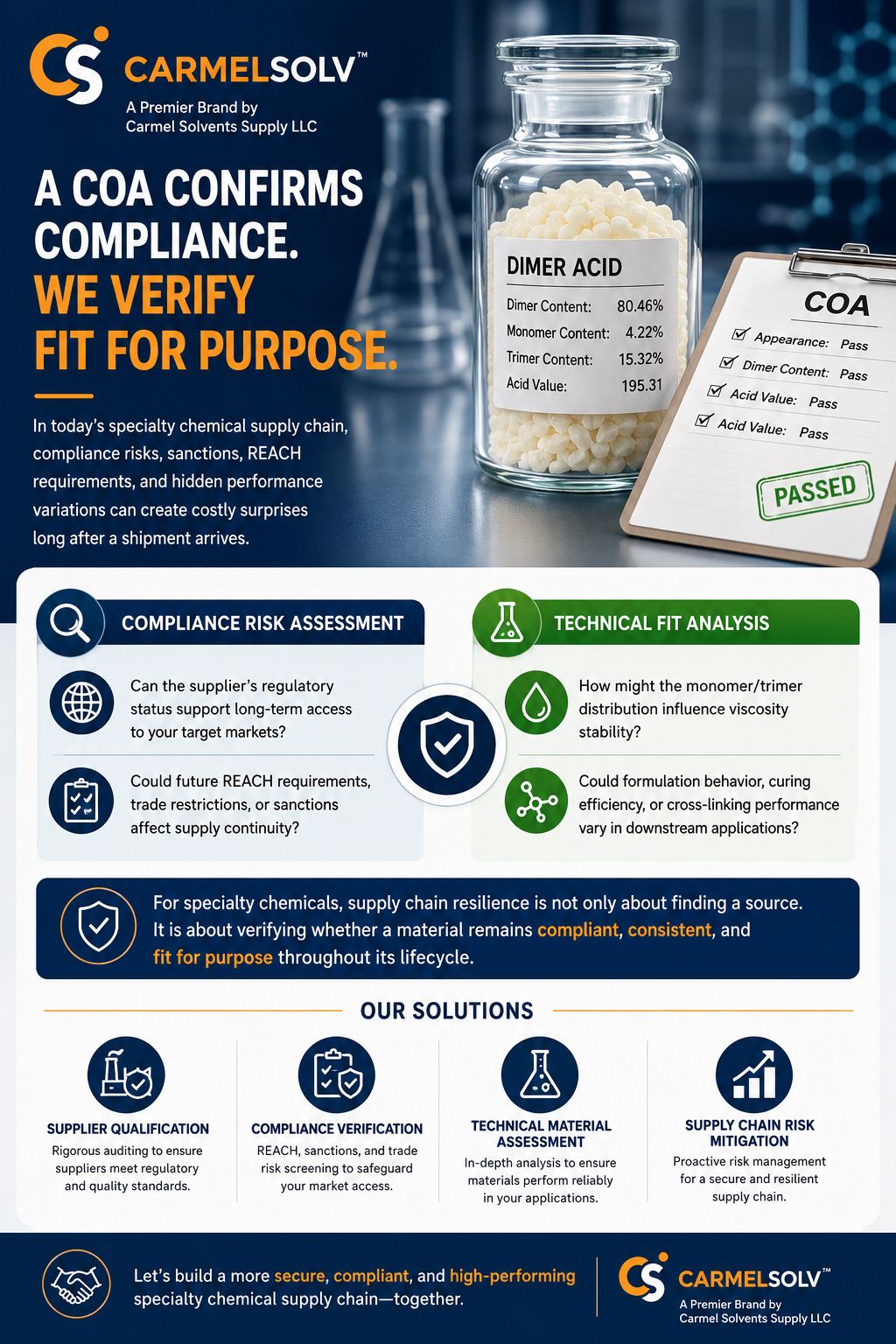
A Certificate of Analysis (COA) can confirm that a material meets agreed technical specifications. However, it does not always confirm whether that material is truly suitable for your process, your downstream application, or your target market.
In today's specialty chemical supply chain, technical variation, regulatory requirements, trade restrictions, supplier qualification gaps, and hidden performance risks can create costly surprises long after a shipment arrives.
Recently, we reviewed a batch of Dimer Acid with the following key parameters:
- Dimer Content: 80.46%
- Monomer Content: 4.22%
- Trimer Content: 15.32%
- Acid Value: 195.31
At first glance, the material appeared to meet the stated specification.
However, a deeper technical and supply-chain review raised several important questions.
Compliance and Supply Chain Risk Assessment
A compliant COA does not answer every commercial or regulatory question.
Key questions include:
- Does the supplier's compliance framework support long-term access to the target market?
- Are REACH, sanctions, trade restrictions, or other regulatory requirements relevant to the intended destination?
- Could future regulatory changes disrupt supply continuity?
- Is the supplier able to provide consistent documentation, traceability, and shipment support over time?
For specialty chemicals, the risk is not always visible in one batch document. It often appears later through customs delays, customer qualification issues, or supply interruptions.
Technical Fit Assessment
Specification values also need to be evaluated in the context of the final application.
For Dimer Acid, key questions may include:
- How could the monomer, dimer, and trimer distribution influence viscosity stability?
- Could downstream formulation behavior change between batches?
- Will curing efficiency, cross-linking behavior, or final material performance remain consistent?
- Are the tested parameters sufficient for the customer's actual production process?
A material may meet a general specification but still behave differently under real processing conditions.
Why Fit-for-Purpose Verification Matters
For specialty chemicals, supply chain resilience is not only about finding a supplier.
It is about verifying whether a material remains:
- Compliant for the intended market
- Consistent across batches
- Technically suitable for the application
- Traceable through the supply chain
- Reliable for long-term commercial use
This is where technical review and supplier qualification become critical.
CarmelSolv Verification Approach
At CarmelSolv, we focus on helping customers reduce uncertainty across the specialty chemical supply chain through:
- Supplier Qualification
- Compliance Verification
- Technical Material Assessment
- Documentation Review
- Supply Chain Risk Mitigation
- Fit-for-Purpose Evaluation
Our goal is to help customers build more resilient, reliable, and sustainable specialty chemical supply chains.
Discussion
What challenges are you currently facing in supplier qualification, material verification, or regulatory compliance?
I would be interested in hearing how others approach technical verification and supply chain risk management in specialty chemicals.