In functional textiles and advanced materials, breakthrough performance is rarely limited by scientific creativity alone.
Many projects demonstrate strong results in the laboratory, but fail to achieve commercial success because the material system, manufacturing pathway, and supply chain behind the innovation cannot scale reliably.
Whether the application involves advanced surface modification, high-durability barrier fabrics, specialty coatings, or high-performance substrates, market readiness depends on more than a promising formulation. It requires an executable pathway that connects original research, validated raw materials, downstream processing capability, and commercial supply reliability.
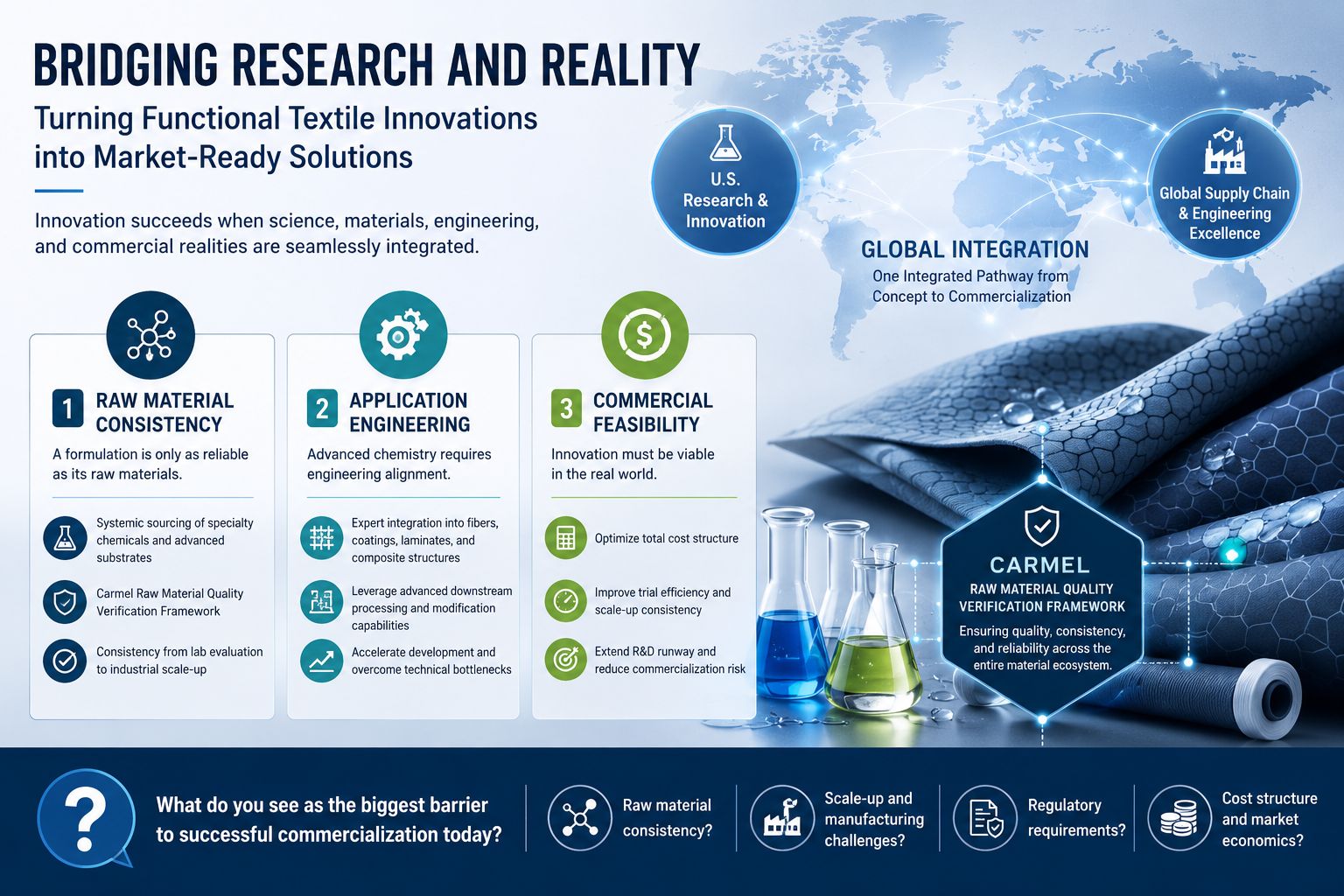
For functional textile projects, the transition from research to commercialization depends on alignment across three critical pillars.
1. Sourcing and Material Consistency: The Material System Advantage
A formulation may deliver excellent laboratory results, but inconsistent upstream materials can introduce hidden variables that affect reproducibility during scale-up.
Small differences in raw material quality, moisture content, purity profile, acidity, or batch consistency may influence coating behavior, polymer compatibility, drying performance, wash durability, and final product stability.
This is why material validation must begin before commercial production, not after problems appear.
Through the CarmelSolv raw material qualification and verification process, we focus on reducing material-related uncertainty from early sampling through industrial implementation. Key priorities include:
- Chemical identity verification
- Batch-to-batch consistency
- Critical parameter control
- Supplier qualification
- Documentation and traceability
- Long-term material continuity
A reliable material system gives R&D teams and manufacturers a stronger foundation for scale-up.
2. Downstream Application and Engineering Alignment: The Functional Application Advantage
Sourcing the right materials is only part of the challenge. Functional textile commercialization also requires the correct integration of advanced chemistries into polymer matrices, textile fibers, fabric surfaces, coatings, or composite structures.
This stage often determines whether a lab-scale concept can survive real manufacturing conditions.
Processing variables such as coating method, drying temperature, curing profile, substrate compatibility, additive distribution, and production speed can significantly affect final performance. Without close alignment between formulation design and downstream engineering, promising technologies may encounter instability, poor durability, or inconsistent results during pilot-scale trials.
A strong commercialization pathway requires technical coordination between material suppliers, formulation teams, and manufacturing partners. This alignment helps identify processing bottlenecks earlier and supports the development of stable, scalable textile systems.
3. Trial Efficiency and Total Cost Optimization: The Commercial Feasibility Advantage
Successful commercialization requires both technical performance and economic feasibility.
Even when a technology works, it may fail commercially if raw material costs are too high, trial cycles are too slow, supply channels are unstable, or manufacturing adjustments become too expensive.
By using verified sourcing channels, clearer technical documentation, and more structured material qualification, R&D teams can reduce unnecessary trial repetition and improve development efficiency. This supports better cost control, faster decision-making, and a clearer path from laboratory validation to commercial production.
The goal is not only to reduce procurement cost. The goal is to build a material and supply framework that gives innovation enough stability, predictability, and cost discipline to reach the market.
Conclusion
Innovation does not succeed through isolated research alone.
It succeeds when scientific concepts, raw material systems, manufacturing capabilities, and commercial realities are engineered into a unified execution strategy.
That integration defines the difference between a promising laboratory result and a market-ready functional textile technology.
Industry Discussion
For professionals working in advanced materials, functional textiles, specialty chemicals, and industrial scale-up:
What do you see as the primary barrier to successful commercialization today?
Is it material consistency, manufacturing alignment, cost structure, supply chain reliability, or something else?
Technical discussion is always welcome.