A single surfactant cannot do everything well. High-performing detergent formulations combine multiple surfactants because no individual ingredient can simultaneously deliver optimal cleaning, foam quality, mildness, viscosity, and cost efficiency. The most effective approach is a structured surfactant system — one where each component has a defined role.
Many people outside the formulation lab assume that a detergent formula only needs one cleaning ingredient. In practice, the difference between an average detergent and a market-leading product often comes down to the surfactant system: which ingredients are selected, at what ratios, and how they interact.
The Foundation: Primary Surfactants
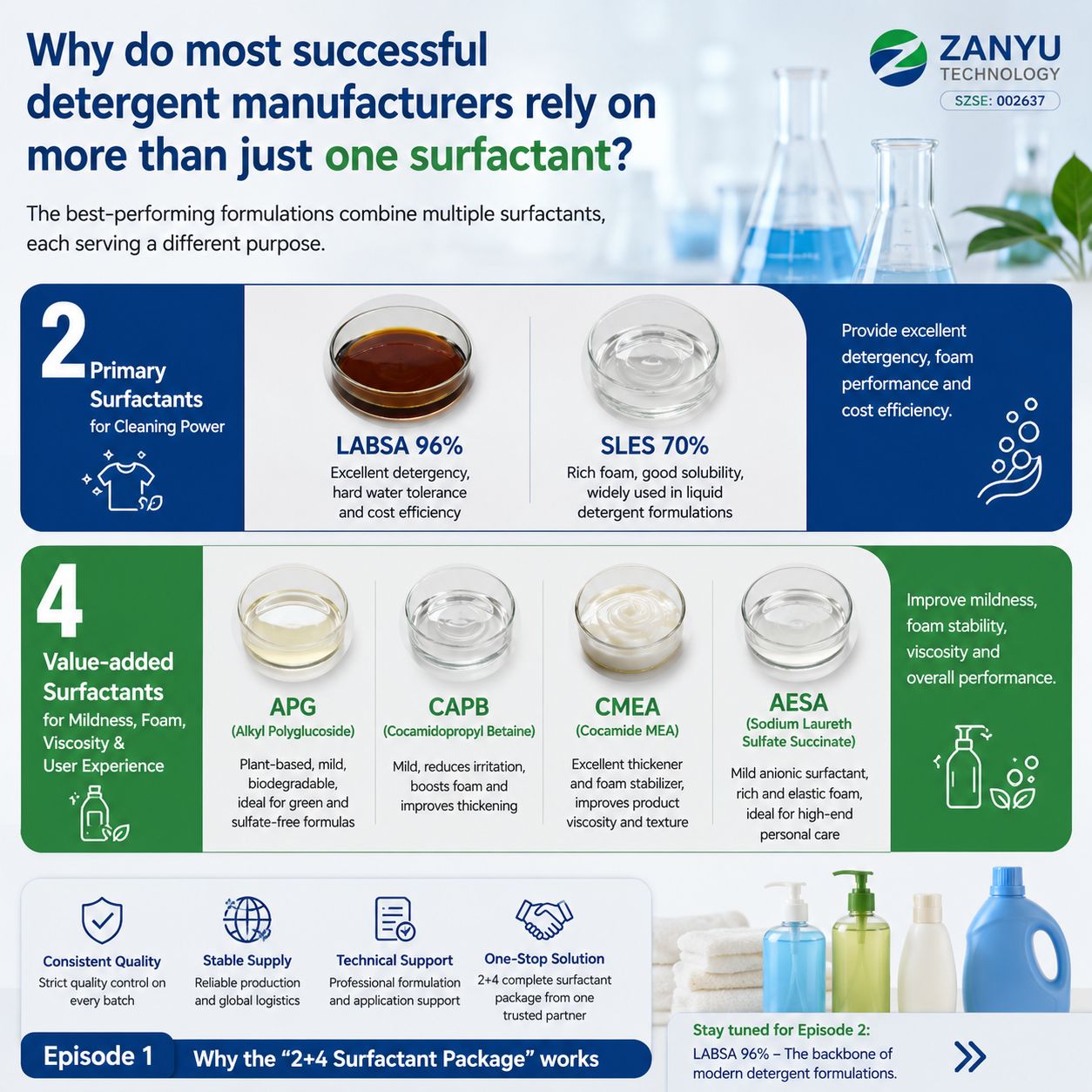
A typical detergent system often begins with two primary surfactants that provide the core cleaning performance:
- LABSA 96% — Dodecyl Benzenesulfonic Acid. Neutralized in-situ or supplied as the sodium salt (LAS), LABSA is the highest-volume anionic surfactant in the world for a reason. It delivers powerful grease-cutting detergency, excellent foam generation, and cost efficiency at scale. It forms the backbone of most laundry powder, dishwashing liquid, and industrial cleaner formulations.
- SLES 70% — Sodium Lauryl Ether Sulfate. The ether sulfate structure provides strong detergency with better hard-water tolerance and a milder skin profile than lauryl sulfate alternatives. SLES is the primary surfactant in most liquid detergent and personal care formulations, where its viscosity-building response to salt and betaine co-surfactants gives formulators precise control over product rheology.
Together, LABSA and SLES form the foundation of many detergent formulations because they provide strong detergency, effective foam performance, and good cost efficiency. However, cleaning power alone does not determine the quality of the finished product.
Improving the Overall Formulation
To improve mildness, foam stability, viscosity, and the overall user experience, formulators may also incorporate additional surfactants and foam-supporting ingredients. These secondary and specialty surfactants do not replace the primary system — they enhance it:
- APG — Alkyl Polyglucoside (APG-0810, APG-1214, APG-0814). A sugar-based nonionic surfactant derived from renewable feedstocks. APG provides excellent skin compatibility and is readily biodegradable. In detergent formulations, it boosts foam quality, reduces the irritation potential of the primary anionic system, and performs well across a wide pH range.
- CAPB — Cocamidopropyl Betaine (CAB 30%). An amphoteric surfactant that pairs with anionics to boost foam volume and stability while significantly reducing irritation. CAPB is the industry-standard co-surfactant for mild formulations — baby care, facial cleansers, and premium hand soaps — where it also contributes viscosity building in combination with salt.
- CMEA — Coconut Monoethanolamide. A solid-form nonionic foam booster and opacifier. CMEA provides pearlized appearance and viscosity enhancement in opaque shampoo, body wash, and syndet bar formulations. Unlike liquid amides, it adds body and texture to the finished product.
- AESA — Ammonium Lauryl Ether Sulfate (ALES 70%). The ammonium-neutralized ether sulfate offers a different sensory profile from its sodium counterpart. AESA is preferred in formulations targeting a specific skin feel — often described as richer or more luxurious — and is commonly used in premium personal care and detergent products.
Each ingredient contributes different performance characteristics. When used together, they can help formulators create a more balanced and effective detergent system — one that cleans well, feels good on the skin, looks right on the shelf, and remains stable over its shelf life.
The 2 + 4 Surfactant Package
We refer to this combination as the 2 + 4 Surfactant Package:
- Two primary surfactants for core cleaning performance — LABSA 96% and SLES 70%
- Four supporting ingredients for formulation enhancement — APG, CAPB, CMEA, and AESA
Rather than purchasing individual raw materials from several suppliers — each with separate documentation, lead times, minimum order quantities, and quality specifications — many detergent manufacturers prefer working with one reliable partner that can provide a complete surfactant solution with consistent quality, documentation, and supply support.
This approach simplifies procurement, reduces the administrative burden of managing multiple supplier relationships, and ensures that all six ingredients are sourced to compatible specifications. When a formulation issue arises, having one point of contact for the entire surfactant system makes troubleshooting faster and more effective.
The 2 + 4 approach isn't about limiting choice — it's about building a surfactant system where every ingredient earns its place.
— CarmelSolv formulation philosophy
What We Will Cover Next
Over the next few weeks, we will introduce each product in the 2 + 4 package individually and explain:
- Where it is commonly used in detergent and cleaning formulations
- Why formulators choose it over alternatives
- Which quality indicators matter most when sourcing
- How it can improve detergent performance in specific applications
Next in the series:
Episode 2: LABSA 96% — The Backbone of Modern Detergent Formulations
Get in Touch — Surfactant Package
If you are formulating a detergent product and want to discuss the 2 + 4 surfactant package — or any individual surfactant — we can provide pricing, typical specifications, and availability. All specifications are confirmed at quotation.